

From the bias of a computer scientist who works making a product for companies to analyze their data
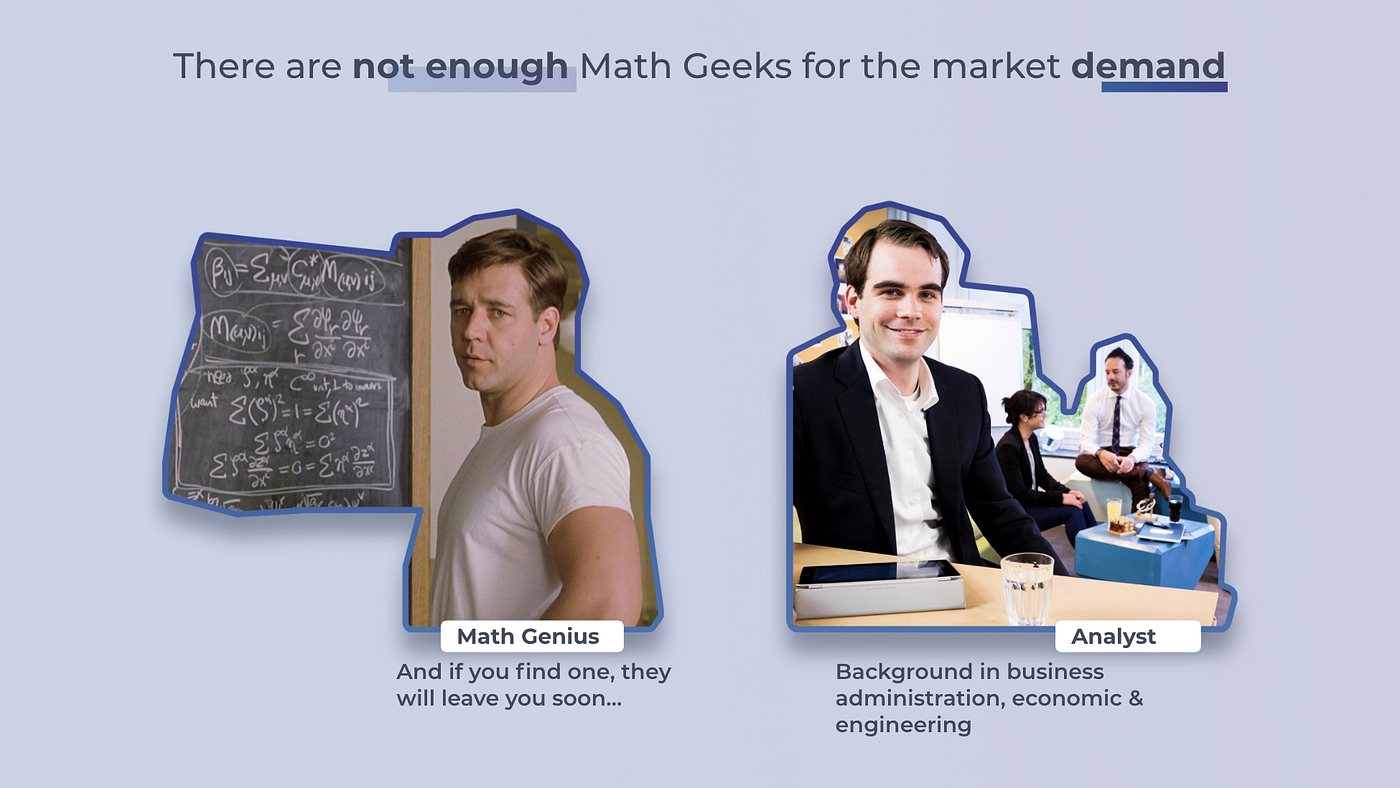
One of the slides I usually use in our Graphext presentation for investors
Following a tweet I wrote the other day,
publishes in El Confidencial
and since I did not have time yesterday to talk with him, here I collect the main points of how I see
what you learn in degrees
vs
what the job market demands
:
What kind of person are you?
If in high school you thought math was something much bigger, elegant and powerful than what they taught you in class and you were bored, memorizing procedures to calculate things instead of learning to represent real world phenomena in numbers, vectors, operations and functions that can solve real world problems... If you have read on your own a book about math or physics, if your parents are math teachers and you have absorbed it since you were a child, and if you already know some programming and you see the appeal...
then maybe it is a very good idea that you study mathematics and if you have the capacity for work try the double degree with Computer Science. You will be able to advance this field, research at the University or in leading companies like Google Deepmind or in cool startups like
.
If in high school you saw the point of math but you are a very curious person, you are interested in a bit of everything and more pragmatic, you need to see short term results to motivate yourself and you crave autonomy (even one day starting your own company) then maybe it is better that you do computer science.
I think that to be happy in a profession you have to feel good at it and for that you must have the motivation to understand well what it is for and be able to have small rewards (and computer science is much more rewarding than Mathematics or Physics)
The job market of data analysis
What is really done today with data in most companies?
The Data Engineers
Basically joining data that is scattered across various databases, cleaning it and applying simple aggregation functions with queries in SQL, Python or map reduce with Spark in the most advanced cases. These profiles are called data engineers and they earn quite well. They will not teach you anything or almost anything about this in the Mathematics degree, in Computer Science they will.
The Business Analysts
Then they visualize this data in a dashboard to see trends in bar and line charts. Big companies might want to make this very customized and for that they need programmers (not mathematicians), others will use Business Intelligence tools, like Tableau, Qlik or Power BI and for that you do not even need to know how to program.
To interpret those dashboards but above all to design them you need good notions of statistics but that is something that any engineer, statistician can easily learn, even people who come from certain social sciences degrees, Business Administration, Economics...
With that base I think it is more than enough, what will differentiate you here in the market will be the experience you gain interpreting niche data (financials of a bank, marketing returns on advertising investment, electoral data etc) but you do not need to study Math.
Before these people were basically the Excel geeks, now they use tools that ingest more data volume and are more flexible painting charts to make descriptive statistics reports/presentations in Powerpoint. These people are called in English "Business Analysts"
and they are in high demand (of all the profiles I mention it is probably the one you find the most open offers for) both in consulting and in any medium large company. Right now in Madrid there can perfectly be more than 20 to 30 masters/programs between public and private centers training people to analyze data at that level. So there is also more and more competition. They earn between 25K (junior) to 40 to 50K (seniors)
The Data Scientists
Then there are the "data scientists" who are the ones who do things beyond descriptive statistics on the KPIs (variables that indicate how the business is doing), these rather than describing the data aspire to create models (that combine many variables) to predict the future.
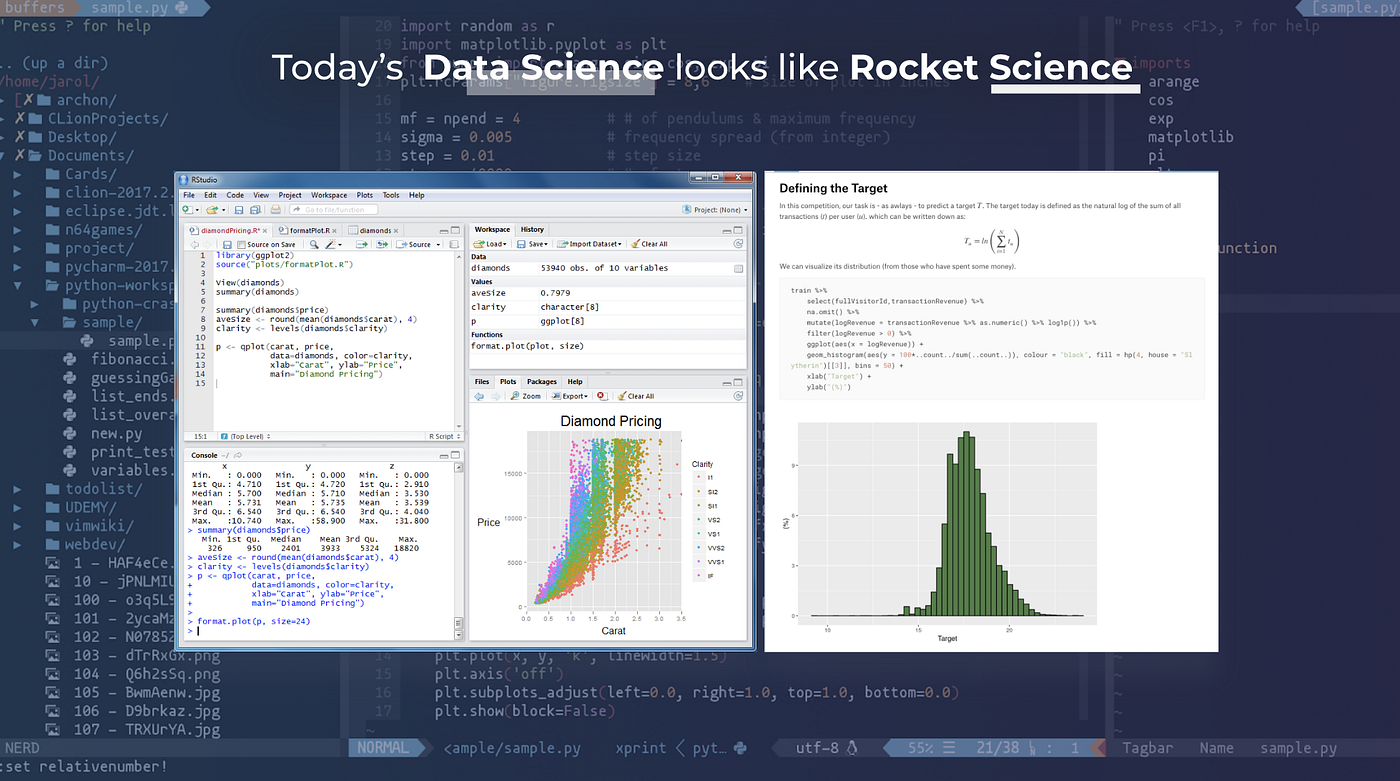
Another slide from the investor deck of Graphext
These profiles are also in high demand, but the reality is that very few companies in Spain have large data science teams. All the IBEX says they have them but most subcontract consulting firms like McKinsey, BCG... only banks and telcos have more than 10 people per team.
Besides there are tools that are automating and making them more productive like our @graphext ;) @DataRobot ,
Creating models to predict which customers have more possibility of leaving or how much stock stores need is now a bit artisanal but it will stop being so.
Right now using Xgboost or any algorithm is using a Python library and playing to tune parameters and treat the variables so it works better. Obviously knowing math helps but a computer scientist should not have so much problem learning it fast (in many specialties it will in fact be part of the curriculum) and besides they will have more capacity so that the code they write can be integrated into the whole system of the company without them needing to hire another person. You can also learn data science on your own by doing Coursera courses or watching videos by Jaime Altozano.
If for a bank optimizing that algorithm a few tenths to give credits has a strong economic impact it might be good for them to have some mathematicians who understand everything very very deeply but they do not need more than 1 or 2, they need many more engineers.
Besides if you have studied computer science and the mathematical guts pique your curiosity you can always do masters in mathematics and you will have many more gained intuitions (although the most probable thing is that you already earn well, have a partner and little time and you do not end up doing it) :P
in fact most of the great minds that are advancing the world of data science today have studied computer science like @demishassabis , @ylecun , Mikolov, Leskovec, @AndrewYNg , @JeffDean , @alexjc look at their Linkedins. In the past those who advanced the field were mainly mathematicians and physicists because Computer Science did not exist.
Knowing mathematics in the end are intuitions about how to operate with vectors of numbers and combinatorics, something that we computer scientists develop much faster with our language that gives us constant feedback and not with blackboards with hieroglyphs. In this talk Conrad Wolfram explains it very well.
that is why I would almost always recommend studying Computer Science instead of Math (alone).
Please the world needs many more computer scientists, lots of wonderful ideas for all sectors (health, financial, transport, education) that are not done due to lack of people.
All these jobs are very well paid, it would be rare for you to earn less than 40K a year in any of them (which compared to the rest of professions is a huge salary in Spain). Besides many companies give a lot of flexibility and will let you work remotely from provinces without having to move to Madrid or Barcelona. And we will increasingly see more data scientists, data engineers who pass 60K (which right now I would say is the glass ceiling) and they will earn more than many managers.