

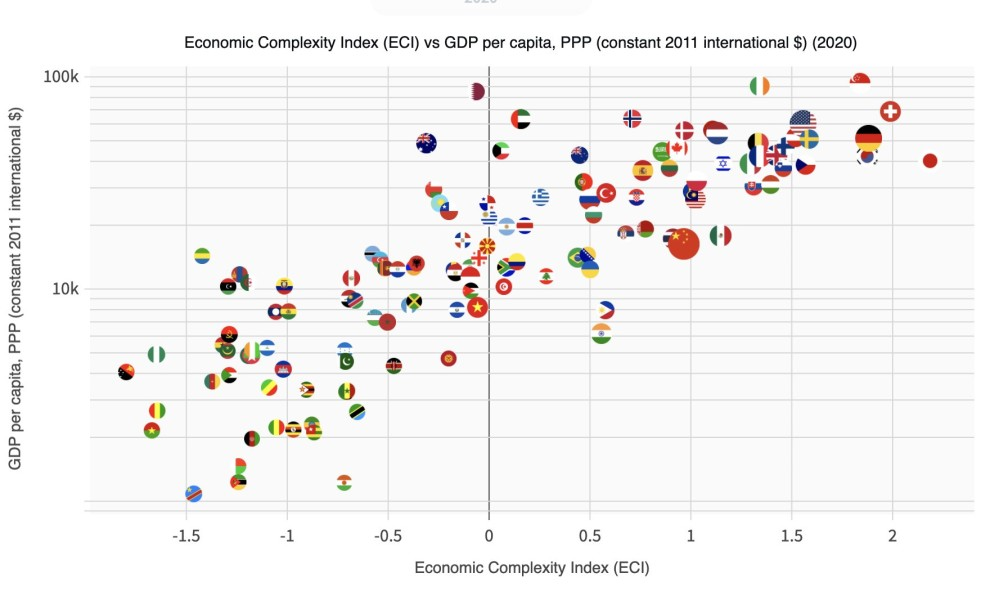
There's a great indicator for predicting how well a country's economy will develop. It is based on the diversity and originality of the products a country knows how to manufacture and export, which @cesifoti and @ricardo_hausman refer to as the Economic Complexity Index.
For instance, Spain manufactures and exports many different and diverse products, but those requiring more specific knowledge (like car engines) are becoming less original as more countries are learning how to manufacture them, leading to potentially lower margins.
On the other hand, South Korea or Taiwan, despite manufacturing less diverse products, have in recent decades learned to produce new technological products like liquid crystal panels that few countries are currently exporting. Therefore, their economies appear to be more prosperous in the future.
Lately, I've been thinking a lot about how creating software is one of the most complex products to manufacture. It requires the most expensive human capital in the world (developers, designers, sophisticated marketers…).
However, not all software is created equal. For example, making a simple app for selling second-hand stuff can be done in a few weeks, while creating advanced software for designers like Figma or Webflow took them 5 to 10 years just to get the first basic versions out.
There isn't the same moat, nor does it require the same investment. Therefore, one can expect very different margins in the medium to long term in the software industry.
In fact, what's happening with AI lately is very interesting. A bunch of new startups are basically just building simple tools around OpenAI's API, which get really popular fast, but then a few weeks later, ChatGPT comes out with that same feature built right in.
The startups that will be worth more are the ones that mix AI with complex UIs that are hard to make, or have unique data that's hard to get or produce elsewhere, or can actually compete with big foundational AI models.
Unfortunately, there is no available data to measure the complexity of the software that each startup manufactures in a more or less objective manner. @Crunchbase or @PitchBook do not have this information to create an Observatory of Economic Complexity like the one done by @cesifoti.
https://next.oec.world/en/profile/country/esp#economic-complexity
It would be extremely valuable for VCs and entrepreneurs and help predict each country's future in addition to industrial products.
By the way, @Cotec_Innova and @cesifoti have just released an analysis of the complexity of the economy of each province in Spain. https://complejidadeconomica.cotec.es/
It clearly shows how Basque companies lead the ranking by manufacturing, for example, trains, while those in the south are limited to exporting only agricultural products.