The best argument against remote work I've come across. A company is a machine for creating knowledge.
If the knowledge created from the daily experiences of its employees (talking to customers, researching what competitors do, programming an internal library, etc.) remains tacit (resides only in the minds of employees who often will forget and will leave the company) and is not transmitted, combined, and internalized, the company ends up dying unless it has artificial entry barriers (oligopolies, public companies...)
The first step to converting tacit knowledge into explicit knowledge is to socialize it. Verbalize what you've learned with another colleague. Ideally, this should happen naturally and in the rawest possible form. And people should enjoy doing it.
When we try to synthesize it by writing, many nuances that are fundamental get lost.
I think this is why Loom is so cool and many people are using it these days at work. I also think that perhaps for these reasons, Twitter is so popular and powerful for generating knowledge among knowledge workers and people who work remotely. As the messages are short and very "real-time", it encourages people to share tacit knowledge in a very distilled way, with a lot of emotional load and a lot of social context to interpret it.
It's experiential knowledge where the tone in which the client told you how important that feature was to them is perhaps the most important thing. And the tone in which your colleague conveys it is also important. Almost any feedback and learning are important, but without the emotional tone, it's very difficult to know what to prioritize and when. PMs know this well!!
This is where I think remote work is still an experience that's x10 times worse than being face-to-face. It's a lot of work to stay focused and enjoy 2-3 hours of socialization through a video call with a colleague. Maybe the Apple Vision Pro will change the experience, who knows.
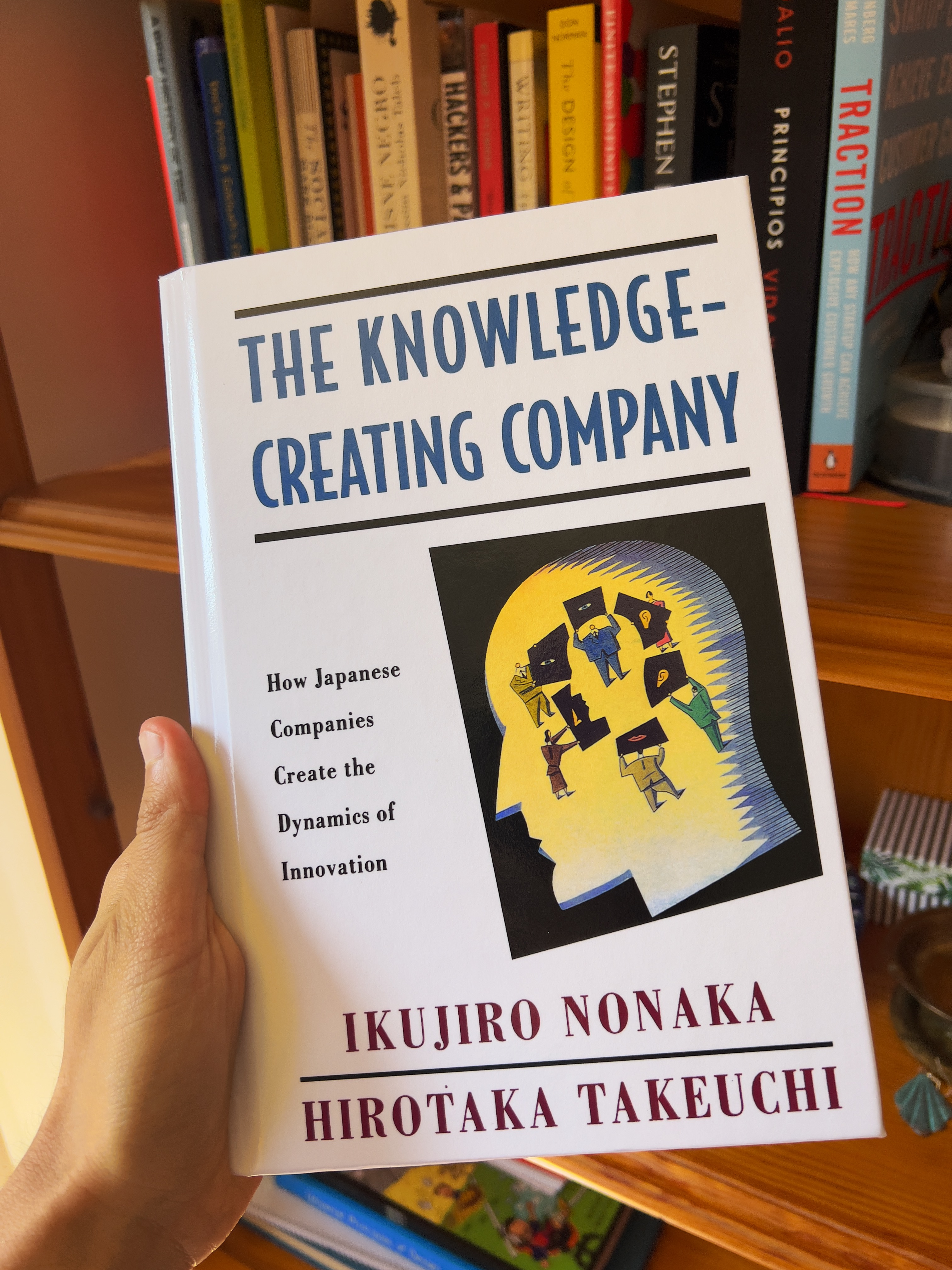
I bought this book a few years ago, The Knowledge-Creating Company, which is about how some Japanese academics have been empirically researching this topic for decades.
And since I didn't get around to reading the entire book, last night I saw it on the shelf (this is why you want to have physical copies of great books at home), and I conducted an interview with the book using ChatGPT, here's the result
https://chat.openai.com/share/9a7fea73-7803-4a44-bb5f-9cdc354f39df